

Freeletics went from 15% to 68% answer share in 90 days
Answer share moved from 15% to 68% on tracked high-intent queries during the engagement.
No signup. No email. 60-second scan.
Bull AI Labs × Found on AI
What did Freeletics achieve on AI search?
In 90 days of engineering work, Freeletics went from largely absent in AI answers to being named on the queries we tracked. Answer share moved from 15% to 68% on tracked high-intent queries during the engagement.
Not marketing. Not ad spend. Not backlinks. Code. Crawlability. Content.
What the engagement moved
Answer share moved from 15% to 68% on tracked high-intent queries during the engagement.

Freeletics
135 tracked prompts across ChatGPT, Perplexity, Claude and Gemini
Why was Freeletics invisible on AI search?
Freeletics.com was built as a client-side rendered React application. AI crawlers like GPTBot, ClaudeBot, and PerplexityBot don't execute JavaScript. When they visited Freeletics.com, they received an empty HTML shell containing only <div id="root"> and script tags. None of Freeletics' product information, training plans, or differentiators were visible to AI engines.
The Freeletics product existed in the minds of millions of users. It did not exist in the index of a single AI engine.
<!DOCTYPE html>
<html>
  <head>
    <title>Freeletics</title>
  </head>
  <body>
    <div id="root"></div>
    <script src="/main.js"></script>
  </body>
</html>The Three Levers That Moved the Needle
Bull AI Labs's methodology. Applied to Freeletics. Applicable to any brand.
Code
Implementing server-side rendering so AI crawlers could actually read the site. React SPAs return empty HTML to GPTBot, ClaudeBot, and PerplexityBot. We migrated critical pages to SSR-compatible rendering.
- Server-side rendering (SSR) deployment
- Pre-hydration content delivery
- Clean semantic HTML structure
- Eliminated JavaScript rendering dependencies
Result: 100% crawler-readable HTML on first fetch
Crawlability
Configuring the technical access layer so every major AI crawler could discover, parse, and understand the site. Fixed robots.txt, implemented schema markup, eliminated 404 bleed.
- Explicit robots.txt directives for GPTBot, ClaudeBot, PerplexityBot, ChatGPT-User
- Product, Offer, FAQPage JSON-LD schema
- Fixed 404 hemorrhaging across AI crawl budget
- Cloudflare AI bot allowlisting
Result: 100% crawler access across all major AI engines
Content
Restructuring pages with answer-first formatting, specific factual claims, and structured extractability. AI engines cite content they can confidently parse into clean answers.
- Answer-first heading structure
- Specific factual density (not brand copy)
- Clear product categorization
- Question-based H2 architecture
Result: Freeletics.com was cited as a primary source during the engagement
"Fix one lever, nothing happens. Fix two, you plateau. Fix all three, you overtake a $1.5B competitor."
Across 135 prompts in one of the most saturated categories - fitness app, we went from slightly visible to consistently ranking #2 or higher. Engineering fixes, crawlability improvements, and targeted content changes all working together. Bull AI Labs showed us exactly what AI search invisibility was costing Freeletics in dollars - then fixed it.
Curious where your brand stands? Run a free diagnosis →
The Receipts
We don't publish case studies without proof. Here's what AI engines show when you run the queries yourself.
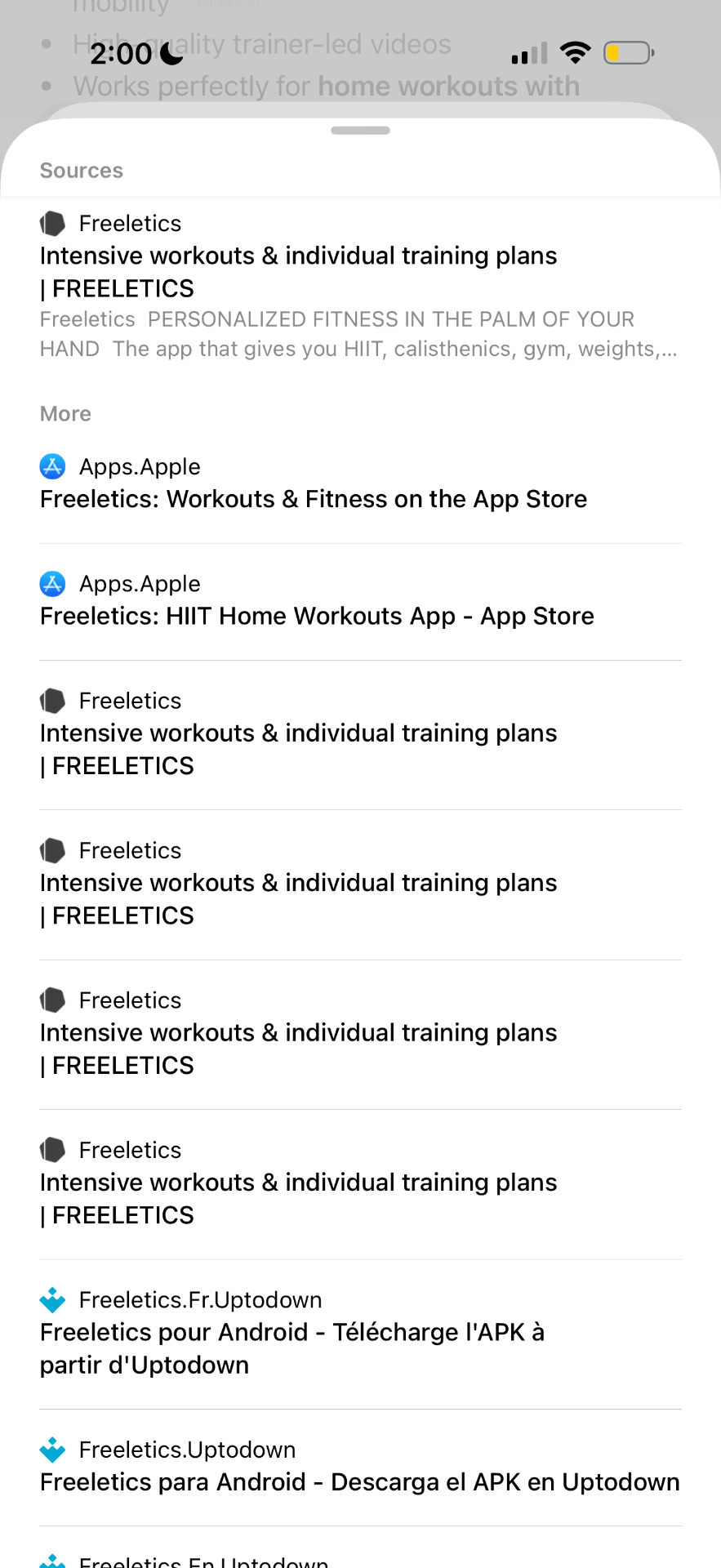
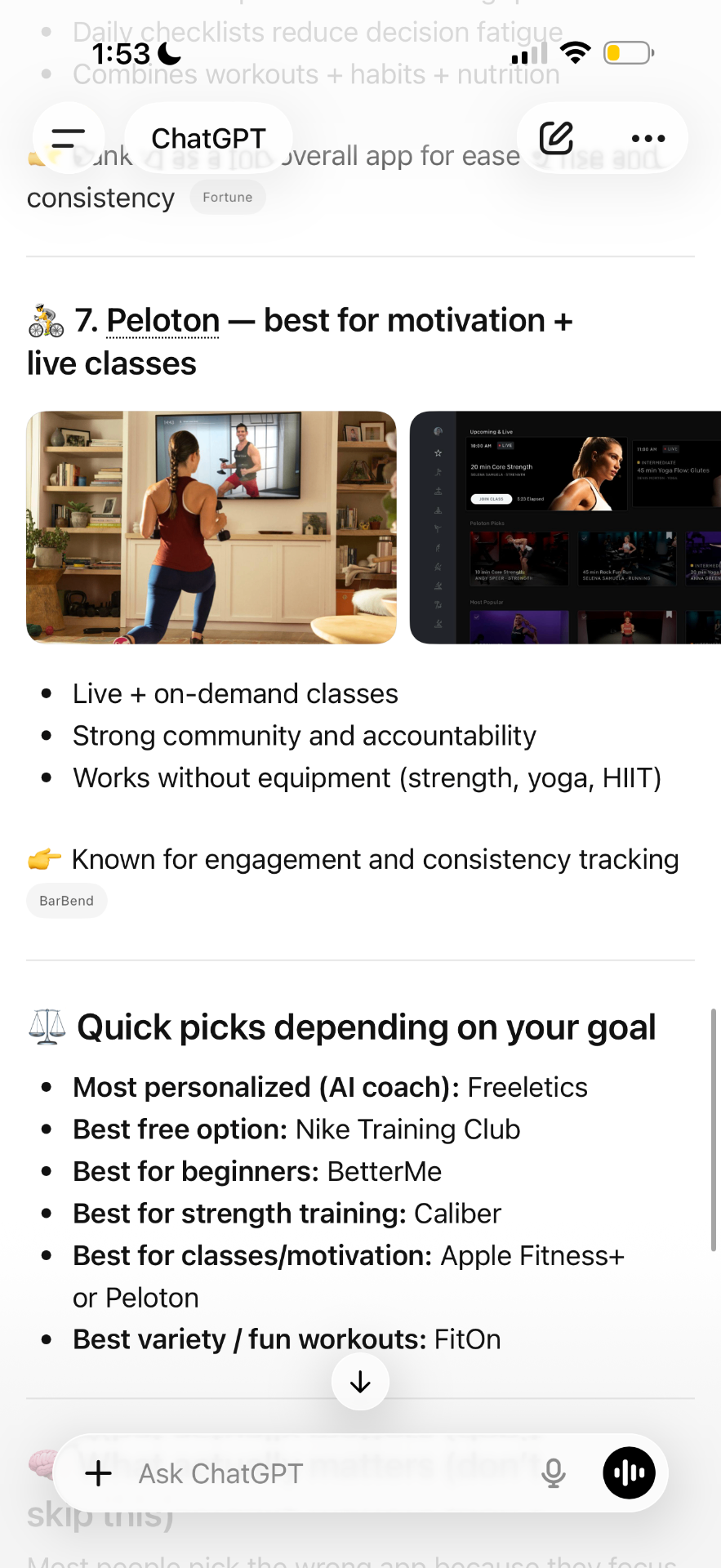
Run the same queries yourself. Ask ChatGPT, Perplexity, or Claude about fitness apps. Answer share moved from 15% to 68% on tracked high-intent queries during the engagement.
Run It Yourself
Open ChatGPT, Perplexity, or Claude. Ask: "What are the best fitness apps for home workouts in 2026?"
Run it a few times. AI search is non-deterministic, so results vary between sessions. Answer share moved from 15% to 68% on tracked high-intent queries during the engagement.
We track thousands of queries across ChatGPT, Perplexity, Claude, and Gemini. The pattern doesn't lie.
We're not asking you to trust us. We're asking you to test it.
Can any brand replicate this?
Yes. The three levers - code, crawlability, and content - apply universally. Any brand whose site returns empty HTML to AI crawlers can implement server-side rendering. Any brand can fix their crawler directives and schema markup. Any brand can restructure content for answer-first extraction. The playbook is replicable regardless of industry, category, or budget.
DTC brands on Shopify, B2B SaaS on Next.js, healthcare platforms on WordPress, fintech apps on React - the fixes vary by tech stack but the methodology is identical. If your site is technically invisible to AI crawlers, no amount of content marketing or ad spend will make ChatGPT recommend you over a competitor whose site renders clean HTML.
Same Playbook · Different Category
Learn the methodology: What is AEO? · More case studies
Frequently Asked Questions
Find out what AI engines retrieve from your site.
Bull AI Labs's free diagnosis scans your site across every major AI engine and shows you exactly where you're invisible, who's showing up instead of you, and what it's costing in real revenue.
60 seconds. No signup. No email required.
Bull AI Labs · Found on AI · Case Study № 001